Expert perspectives, trend analysis, and breakthrough formulation knowledge from industry leaders.
Discover how custom formulation techniques and clean beauty trends are shaping global brands.
Stay informed with regulatory updates, supply chain strategies, and private label guidance.
Choosing a lip gloss supplier can look simple until texture, packaging, testing, and delivery timelines collide. Lip Gloss Contract Manufacturing requires more than comparing unit prices. It demands careful questions, documented processes, and practical judgment.
Cosmetic chemist Perry Romanowski says, “Cosmetic science is a combination of chemistry, biology, physics, and psychology.” That idea matters when evaluating a manufacturer. A glossy finish may look attractive under studio lighting, yet feel sticky after ten minutes. A clear tube may photograph beautifully, yet leak around the applicator. Small details often reveal large production risks.
This guide presents seven practical tips for choosing Lip Gloss Contract Manufacturing partners. It examines formulation expertise, sample quality, minimum order quantities, ingredient transparency, packaging compatibility, quality controls, and production communication. Look for manufacturers that can explain their testing methods, provide complete ingredient documentation, and show consistent batch records. Ask how they manage viscosity changes, color separation, filling accuracy, and stability checks.
Do not rely on impressive presentations alone.
Request real samples.
Speak with the technical team.
A supplier may promise flexibility, but its minimum order can still exceed your launch budget. Another may offer low pricing while giving vague answers about testing. That deserves reflection. The cheapest option is not automatically efficient, and the most polished facility is not always the best fit.
Reliable partnerships grow from evidence, not confident promises. Compare written specifications, inspect packaging samples, and allow enough time for revisions. These seven tips will help you make a more informed decision, although no checklist can replace careful due diligence.
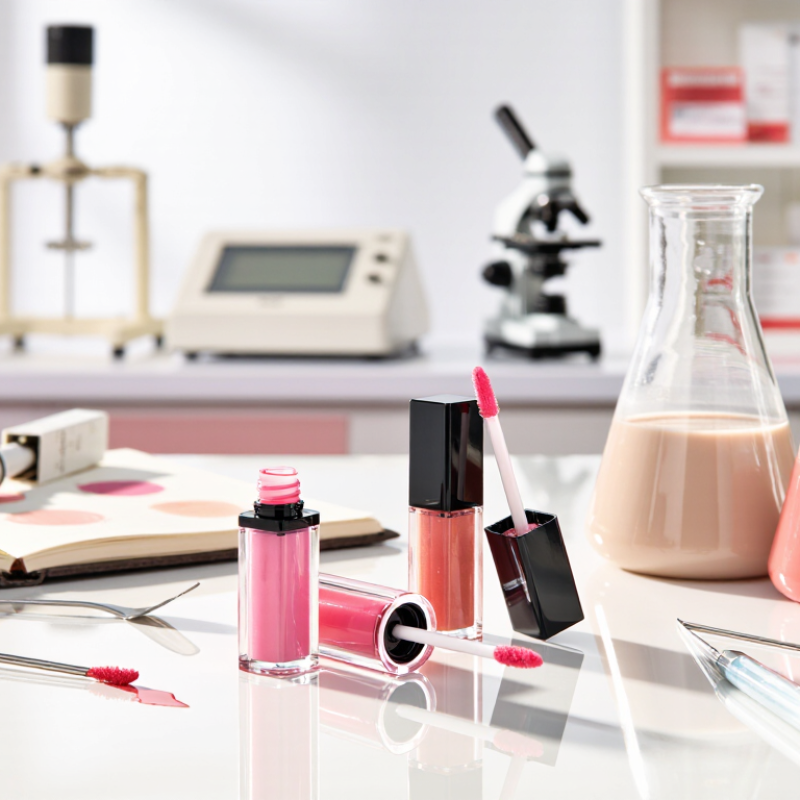
A reliable lip gloss brief starts with measurable targets, not words like “smooth” or “long-lasting.” Grand View Research valued the global lip care products market at approximately USD 4.3 billion in 2023, reflecting strong demand for comfortable, portable formulas. This growth makes precise benchmarking more important for contract manufacturing.
As a practical starting range, test gloss viscosity between 8,000 and 30,000 cP at 25°C. Record the spindle, rotational speed, and test temperature. Otherwise, two laboratories may report different results for the same batch.
Define clear, translucent, shimmer, or high-shine appearance with reference panels and controlled lighting. Measure spread on a glass plate, then inspect stringing after applicator removal. ASTM D2196 can support rotational viscosity testing, but it does not replace consumer evaluation.
A thicker formula may improve cushion and reduce runoff, yet it can feel heavy or pull during application. That trade-off is easy to miss.
Use a controlled panel and assess shine, transfer, tack, and comfort at zero, four, and eight hours. A 2024 consumer study from Circana reported that performance remains a major purchase driver in makeup, but comfort still shapes repeat use.
Set an honest target, such as visible shine for four hours, rather than promising all-day wear without testing. I have seen promising lab samples fail after lunch.
Recheck the formula. Temperature cycling, packaging compatibility, and applicator design can change viscosity and wear results.
Choosing a lip gloss contract manufacturer requires more than comparing quoted prices. Capacity determines whether your launch stays stable when demand changes. McKinsey & Company estimates that the global beauty market could reach about $580 billion by 2027, with roughly 6% annual growth. That pressure makes production flexibility important.
Request the supplier’s minimum order quantity, standard lead time, and actual monthly output. A low MOQ sounds attractive, but it may indicate manual filling or limited production space. Ask how many filling lines can handle viscous gloss, and whether the equipment supports wands, tubes, and different applicator sizes. Confirm batch capacity in kilograms and units. A 500-kilogram tank may not suit a 3,000-unit trial. It may create unnecessary waste.
Lead time needs evidence. Request recent, anonymized production records, including mixing, filling, testing, and release dates. Grand View Research reports continued growth in the global lip care products market, increasing pressure on capable manufacturers. Check whether raw-material purchasing and packaging storage are handled internally. One missing component can delay the entire batch. Ask about backup mixers and filling equipment, too. Not every supplier has them.
Run a pilot batch before signing a large order. Measure fill accuracy, gloss viscosity, settling, leakage, and color consistency after transport. I have seen capacity claims look impressive until a small pilot exposes slow cleaning procedures. That risk deserves attention. A supplier with modest equipment but transparent records may be safer than a larger facility with vague answers.
| Tip | Capacity Dimension | Typical Industry Benchmark | What to Compare | Due-Diligence Question | Selection Guidance |
|---|---|---|---|---|---|
| 1 | Minimum Order Quantity (MOQ) | Approximately 1,000–5,000 units for stock packaging; 5,000–25,000 units for custom packaging or custom components. | Finished-goods MOQ, formula-development MOQ, color MOQ, and packaging-component MOQ. | Is the MOQ calculated per shade, per package format, or across the complete purchase order? | Choose an MOQ that supports forecasted sales without creating excessive inventory or expiry risk. |
| 2 | Production Lead Time | Commonly 6–12 weeks after artwork, raw materials, packaging, and formula approval; custom components may add 4–10 weeks. | Sampling time, procurement time, filling schedule, quality release, and freight preparation. | Which lead-time milestones are fixed, and how are delays caused by component shortages communicated? | Request a written production schedule with approval gates and a realistic buffer for new launches. |
| 3 | Batch Size and Vessel Capacity | Pilot batches are often 5–30 kg; commercial lip-gloss batches commonly range from 50–500 kg, depending on the formula and equipment. | Smallest validated batch, standard commercial batch, maximum vessel size, and scale-up capability. | Can the supplier reproduce viscosity, color, and suspension performance when moving from pilot to commercial scale? | Select a facility whose normal batch range matches your launch volume and future growth plan. |
| 4 | Mixing and Heating Equipment | Suitable equipment may include stainless-steel jacketed vessels, sweep agitation, high-shear mixers, vacuum capability, and temperature control. | Vessel range, mixer type, heating and cooling controls, vacuum de-aeration, and cleaning validation. | What equipment is used for pigment dispersion, wax melting, air removal, and viscosity control? | Match equipment to the formula; high-shear or vacuum capability is valuable for pigments, shimmer, and air-sensitive textures. |
| 5 | Filling and Packaging Output | Semi-automatic lines may produce roughly 2,000–8,000 units per shift; automated lines can exceed 10,000 units per shift, depending on pack size and changeovers. | Filling speed, bottle and wand compatibility, seal application, labeling, inspection, and changeover time. | What is the validated hourly output for the exact container, applicator, and fill weight? | Use validated line output rather than maximum theoretical speed when planning delivery dates. |
| 6 | Quality and Batch-Release Capacity | A controlled process should include documented incoming-material checks, in-process controls, finished-product testing, retain samples, and batch records. | Viscosity, appearance, odor, fill weight, microbial testing where applicable, packaging compatibility, and release documentation. | How many batches can quality personnel release per week without compromising review time or traceability? | Prioritize documented controls and sufficient quality staffing over production volume alone. |
| 7 | Surge Capacity and Supply Continuity | A practical planning reserve is often 15%–30% above forecasted demand, subject to labor, equipment, component availability, and quality-release capacity. | Second production shift, backup equipment, alternate raw-material sources, component safety stock, and business-continuity procedures. | Can the supplier support a 20%–30% volume increase during seasonal demand without extending the agreed lead time? | Select a partner with documented contingency plans and verified access to critical components and raw materials. |
Audit manufacturing quality before discussing price or packaging. Ask for current evidence of ISO 22716 GMP compliance, not only a certificate on a presentation slide. Review procedures for personnel hygiene, equipment cleaning, raw material approval, and contamination control. Walk through the production area if possible. Look for labeled utensils, closed containers, clean floors, and clear material status signs. Small details often reveal whether procedures work daily.
Batch traceability should be tested, not simply described. Select one finished lip gloss batch and request its complete history. Records should connect the batch to raw material lots, weighing sheets, filling times, operators, equipment, laboratory results, and release approval. A reliable manufacturer can trace each unit forward and backward within a reasonable time. Try a mock recall. It exposes weak links quickly. Almost too quickly.
Check retained samples, deviation reports, complaint handling, and corrective actions. A mature quality team discusses problems without hiding them. Perfect records may look impressive, but they can also deserve careful questioning. Ask why deviations occurred and whether actions were verified later. I have found that unclear handwriting, missing signatures, or repeated corrections often signal deeper process pressure. Audit findings should be documented with evidence, owners, and deadlines. Quality is not a promise; it is a trail of controlled decisions.
Packaging compatibility is a practical test of any lip gloss contract manufacturer. A suitable formula can still fail inside the wrong package. Evaluate the wand, wiper, bottle, fill volume, and closure as one system. Small details matter.
Check whether the wand collects enough gloss without excessive dripping. The wiper should remove product evenly, while preserving a smooth application load. Test several insertion and withdrawal cycles, not just one. Observe stringing, trapped air, and product buildup around the neck. Fill samples at the lowest, target, and highest planned volumes. This reveals whether the applicator reaches the formula consistently. Do not guess.
Leakage testing needs controlled handling. Store filled units upright, inverted, and on their sides under different temperatures. Then inspect the threaded area, cap, and shoulder for residue. A short transport simulation can expose problems that a stationary sample hides. Drop testing may also help, but it should match realistic shipping conditions. Overly harsh testing can create misleading failures.
Record the formula batch, package dimensions, torque settings, storage time, and visible changes. Experienced evaluators also check odor, color, viscosity, and applicator performance after conditioning. One overlooked issue is wiper variation between production lots. That is risky. I would not approve packaging from a single successful sample; repeated tests provide stronger evidence. Some failures may come from filling accuracy rather than the package itself, so review both processes before changing components.
Choosing Lip Gloss Contract Manufacturing
Tip 1: Confirm MoCRA 2022 readiness before discussing production volume. Ask whether the facility has completed required registration and product listing procedures. Request written procedures for serious adverse event reporting within 15 business days. Review batch records, complaint logs, and recall simulations. A polished factory tour proves little.
Tip 2: Check every ingredient against current INCI naming requirements. The formula sheet should match the package declaration, including colorants, flavors, and preservatives. Request supplier specifications, allergen details, and lot-level traceability. Shade changes can quietly create labeling errors. I have seen teams overlook minor pigment adjustments.
Tip 3: For European sales, verify compliance with Regulation (EC) No 1223/2009. The manufacturer should support a Product Information File, Cosmetic Product Safety Report, and responsible person documentation. Confirm that product notification through the Cosmetic Products Notification Portal is assigned clearly. Do not accept “EU compliant” as sufficient evidence.
Tip 4: Examine manufacturing hygiene and testing controls. Ask for microbial testing, stability data, packaging compatibility results, and retained samples. Lip gloss applicators may introduce contamination during repeated use. Testing should reflect the real package, not only a laboratory container.
Tip 5: Review label artwork with a qualified regulatory professional. Claims such as “long-lasting,” “clean,” or “hypoallergenic” need supporting evidence. MoCRA, INCI, and EU rules overlap, but they are not identical. A shared checklist helps, yet it can still miss a market-specific detail. That uncertainty deserves a documented review.
The chart shows whether each framework directly addresses key readiness controls. A value of 1 means the control is directly addressed; 0 means it is not the purpose of that framework.
MoCRA 2022 covers U.S. facility registration, product listing, safety substantiation, and serious adverse-event reporting. EU Regulation 1223/2009 requires product notification, safety assessment, serious undesirable-effect reporting, and ingredient nomenclature. INCI is a standardized ingredient-naming system rather than a standalone cosmetics regulation.
Reference basis: U.S. Modernization of Cosmetics Regulation Act of 2022; Regulation (EC) No 1223/2009 on cosmetic products; International Nomenclature of Cosmetic Ingredients terminology.
Capacity affects launch stability when demand changes. A low price cannot fix delayed production or limited equipment.
Ask for MOQ, lead time, monthly output, batch size, and equipment details. Request both kilogram and unit capacities.
Sometimes. It may reflect manual filling or limited space. Confirm production methods before assuming flexibility.
Request recent anonymized records. They should show mixing, filling, testing, and release dates.
It reveals fill accuracy, viscosity, settling, leakage, and color consistency. Small tests often expose slow cleaning or weak processes.
Review hygiene, cleaning, material approval, contamination control, and ISO 22716 GMP evidence. Observe labeled tools and closed containers.
Choose one finished batch and request its full history. Records should link raw materials, operators, equipment, tests, and release approval.
Missing signatures, unclear handwriting, repeated corrections, and unexplained deviations deserve attention. Perfect records also need questions.
Test the wand, wiper, bottle, fill volume, and closure together. Check dripping, stringing, trapped air, and product buildup.
Store samples upright, inverted, and sideways at different temperatures. Inspect the cap, threads, and shoulder after transport simulation.
Choosing the right partner for Lip Gloss Contract Manufacturing requires a clear and systematic evaluation process. Start by defining the product formula requirements, including target viscosity in centipoise (cP), desired finish, coverage, comfort, and expected wear time. Then compare suppliers based on minimum order quantities, production lead times, equipment capabilities, and suitable batch sizes to ensure their capacity matches your launch plans.
Quality and compatibility are equally important. Verify that the manufacturer follows ISO 22716 Good Manufacturing Practices and maintains complete batch traceability. Test applicator wands, wipers, fill volumes, and container materials to identify leakage, wiping, or dosing issues before production. Finally, confirm regulatory readiness by reviewing ingredient documentation, INCI labeling, MoCRA 2022 responsibilities, and applicable EU 1223/2009 requirements. A supplier that combines technical expertise, reliable quality systems, packaging testing, and regulatory support can help create a consistent, compliant, and commercially practical lip gloss product.