Liquid foundation is a small engineering project worn on the face. In 2026, a strong formula must balance shade accuracy, comfortable coverage, stability, and a finish that still looks natural under daylight. That balance starts with the brief: Who will wear it, what skin feel should it deliver, and how should it perform after hours of wear? The answers guide pigment selection, emulsion design, preservation, and testing.
Market signals make the work commercially relevant. McKinsey’s 2024 beauty-market analysis projected global beauty sales could reach about $580 billion by 2027, with roughly 6% annual growth. Circana reported that U.S. prestige beauty sales grew 7% in 2024, reaching $31.7 billion. These figures describe broad beauty categories, not foundation alone. They still point to a competitive market where product performance matters. Cosmetic chemist Perry Romanowski’s published formulation guidance emphasizes practical experimentation: build prototypes, evaluate them, and refine the formula. That is a useful discipline for Liquid Foundation Formulation, not a guarantee of success. A silky sample can separate in its jar. A perfect swatch can look orange at a window. Small details matter.
This guide examines ingredient roles, pigment dispersion, shade development, texture, stability checks, and scale-up considerations. It treats testing as part of formulation, not an afterthought. No formula is universally ideal. Skin tone, climate, packaging, and user preference can change the result. That deserves honest attention.
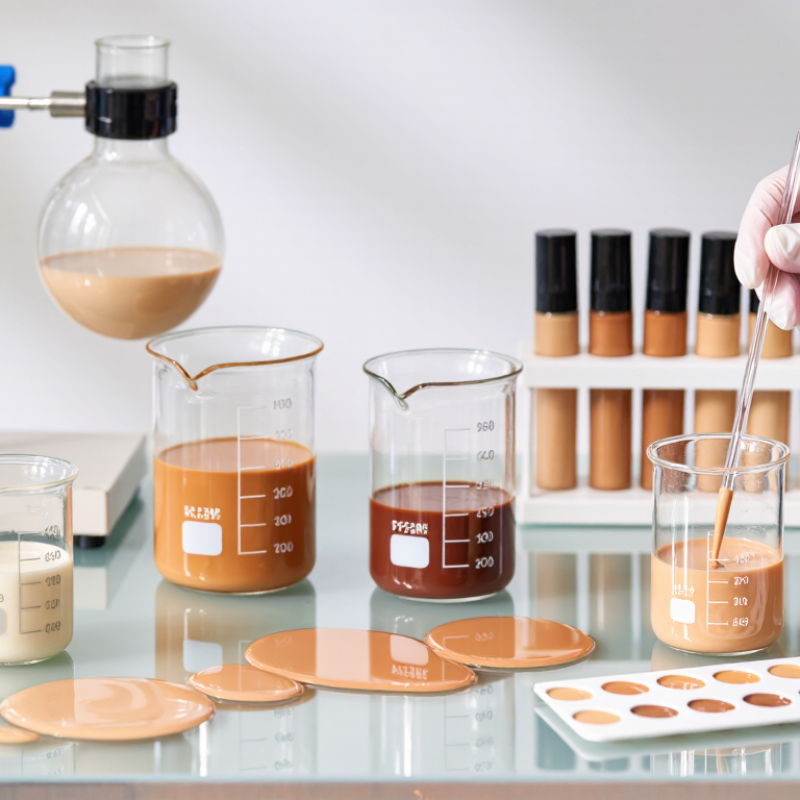
Define the Liquid Foundation’s Performance and Skin-Type Goals
Before choosing pigments or thickeners, define what the foundation must do. Should it provide sheer, buildable coverage, or conceal redness in one layer? Decide how it should feel after application: fluid and quick-setting, or creamy with more playtime. These choices guide the formula’s pigment load, oil phase, and rheology. They also make testing more useful.
Skin type changes the brief. For dry skin, assess whether the formula spreads evenly over flaky areas without emphasizing texture. For oily skin, check shine and pigment movement after several hours, not just at application. Combination skin needs a closer look across the cheeks and T-zone. Sensitive skin calls for cautious ingredient selection and appropriate safety assessment; “gentle” should be demonstrated, not assumed. Keep claims tied to evidence.
Set practical targets for shade accuracy, coverage, transfer, and wear time. Test on clean skin and over common skincare layers, then inspect in daylight and indoor lighting. Record changes in color, separation, and feel. A shade can look right in the lab, then turn warmer on skin. That happens. Repeat tests with controlled amounts and more than one skin tone before adjusting the formula. The first target may be wrong. That is useful information.
How to Formulate Liquid Foundation in 2026? — Define the Liquid Foundation’s Performance and Skin-Type Goals
Set performance priorities before choosing the formula. This chart uses qualitative planning scores (1 = lower priority, 5 = higher priority), not measured product results or universal skin-care recommendations.
Use these priorities as a starting point: adjust coverage, wear, finish, and feel through prototype testing. Confirm stability, preservation, and skin compatibility for the finished formula.
Select Pigments, Emollients, and Water- or Oil-Based Ingredients
How to Formulate Liquid Foundation in 2026?
Start with the pigment blend, not the shade name. Iron oxides create most skin-tone colors, while titanium dioxide can add opacity and brightness. Pre-disperse pigments in a compatible emollient, then check the mixture on skin in daylight. A streak on the jaw often reveals undertones that a white lab tile hides. Keep notes by weight; small pigment changes can shift a shade noticeably. There is no universal pigment ratio, so coverage and finish need testing. Cosmetics Europe reported €96 billion in European cosmetics and personal-care retail sales in 2023. That broad market figure signals scale, not a formula target.
Choose the water or oil phase around the feel you want. Water-rich foundations can feel light, but need a suitable emulsifier and a robust preservation plan. Oil-rich systems may offer more slip, though they can feel heavy on some skin. That trade-off is real. Add emollients gradually and compare spread, dry-down, and transfer on a clean glass plate and on skin. For water-containing products, ISO 11930 describes methods for evaluating antimicrobial protection; stability and preservation testing should match the finished formula. Don’t trust appearance alone. Recheck shade, separation, and texture after temperature changes. A formula can look elegant in the beaker and still wear poorly by noon.
How to Formulate Liquid Foundation in 2026? - Select Pigments, Emollients, and Water- or Oil-Based Ingredients
Illustrative starting point for a medium-coverage oil-in-water liquid foundation. Percentages are by weight and the example formula totals 100%. Ingredient ranges are general formulation guidance, not a universal finished-product specification.
| Phase |
Ingredient / INCI example |
Formulation role |
Typical starting range (% w/w) |
Example formula (% w/w) |
| Water |
Aqua (Water) |
Continuous phase and carrier; adjust to bring the complete formula to 100%. |
45–75 |
65.70 |
| Water |
Glycerin |
Humectant that helps reduce the feel of dryness. |
1–5 |
3.00 |
| Water |
Propanediol |
Humectant and solvent; can contribute to slip and spreadability. |
1–5 |
3.00 |
| Water |
Disodium EDTA |
Chelating agent that binds trace metal ions and can support formula stability. |
0.05–0.20 |
0.10 |
| Water |
Xanthan Gum |
Thickener and suspension aid; helps limit pigment settling. |
0.10–0.50 |
0.20 |
| Oil |
Caprylic/Capric Triglyceride |
Emollient that supports spreadability and a smooth skin feel. |
2–8 |
5.00 |
| Oil |
Dimethicone |
Silicone emollient that can improve slip and reduce tack. |
1–5 |
3.00 |
| Oil |
C12-15 Alkyl Benzoate |
Light-feeling emollient and pigment-wetting aid. |
2–8 |
4.00 |
| Oil |
Glyceryl Stearate Citrate |
Oil-in-water emulsifier; helps stabilize the oil droplets in the water phase. |
2–5 |
4.00 |
| Oil |
Cetyl Alcohol |
Fatty alcohol that adds body and can support emulsion structure. |
0.5–2 |
1.00 |
| Oil / pigment |
Silica |
Texture modifier and oil-absorption aid; may affect slip and finish. |
0.5–3 |
1.00 |
| Pigment |
Titanium Dioxide |
White pigment used for opacity and to adjust shade lightness. |
2–10 |
5.00 |
| Pigment |
Iron Oxides (Yellow, Red and Black) |
Color pigments blended to develop undertone and match the target shade. |
1–8 total |
4.00 total |
| Cool-down |
Phenoxyethanol and Ethylhexylglycerin |
Preservative blend; select and use according to supplier guidance and local regulations. |
Use level depends on blend; commonly around 0.5–1.0 |
1.00 |
| Total |
Illustrative oil-in-water example |
100.00 |
Choosing the Liquid Foundation Base
| Base type |
Continuous phase |
Ingredient selection considerations |
Typical sensory direction |
Key formulation checks |
| Oil-in-water (O/W) |
Water |
Uses an O/W emulsifier system, water-compatible humectants and an oil phase containing emollients and dispersed pigments. |
Often lighter and easier to rinse off than water-in-oil systems. |
Check emulsion stability, viscosity, pigment suspension, microbial protection and compatibility with packaging. |
| Water-in-oil (W/O) |
Oil |
Requires a W/O emulsifier system and suitable oil-phase ingredients; the water phase is dispersed within the oil phase. An O/W formula cannot be converted simply by swapping ingredients. |
Can feel richer and may offer greater water resistance, depending on the complete formula. |
Check emulsion stability, water resistance claims, preservative effectiveness, application feel and packaging compatibility. |
| Anhydrous / silicone-rich |
Oil or silicone; no continuous water phase |
Uses compatible oils or silicones, pigment dispersants and rheology modifiers. Water-based ingredients are generally not suitable unless the system is specifically designed for them. |
Can provide a smooth, slip-focused application; final feel depends strongly on the emollient and volatile-ingredient choices. |
Check pigment dispersion, settling, transfer, volatile loss and compatibility of all ingredients. |
Practical note: Pre-disperse and wet pigments in a compatible portion of the oil phase, then use suitable mixing and milling to reduce agglomerates. Adjust the iron-oxide blend through measured shade trials. Validate stability, preservation, skin compatibility and regulatory compliance for the intended market; do not infer sun protection from titanium dioxide content alone.
Build the Formula and Disperse Pigments Evenly
How to Formulate Liquid Foundation in 2026?
Build the Formula and Disperse Pigments Evenly
A reliable liquid foundation starts with a clear structure: pigments, an oil phase, a water phase, and a suitable emulsifier. Choose materials for the finish and skin feel you want, then check that they work together. Wet pigments in a compatible portion of the formula before combining phases. Add them gradually while mixing, scraping the vessel sides so dry pockets do not hide there. A smooth-looking batch is not always evenly dispersed.
Tips: Use a small test batch. Check a thin drawdown on a glass plate for specks, streaks, or uneven color. Keep notes on mixing time and temperature; small changes can affect texture.
Adjust pigment loading and viscosity in measured steps, rather than correcting several variables at once. Suitable mixing equipment can help break up agglomerates, but excessive shear may add air or warm the batch. In practice, a fresh sample can look uniform and show faint streaks after drying. That is a useful reminder to assess both wet appearance and dried coverage. Record observations, then repeat the test before scaling up. Finally, evaluate stability and preservation with appropriate testing; appearance alone cannot confirm a formula’s quality.
Emulsify, Preserve, and Adjust the Foundation’s Texture
A liquid foundation depends on a stable emulsion, not just a pleasing shade. Choose an oil-in-water or water-in-oil system based on the desired feel and ingredient compatibility. Disperse pigments thoroughly in a suitable phase before combining; dry specks can leave streaks across the jaw. Heat phases only as the emulsifier’s instructions require, then combine them at a controlled speed. A small overhead mixer helps create an even blend without whipping in excess air. Small changes matter.
During cool-down, add heat-sensitive ingredients and a preservative system at the specified temperature and use level. Check the finished pH with a calibrated meter if the formula requires a particular range. Adjust texture in measured increments, since extra water or oil can weaken emulsion stability and change preservation needs. Let a sample rest, then inspect it for separation, graininess, or a watery ring. Watch the edges. Record each batch weight and mixing time; a smooth first pour is a useful clue, not proof of stability. Before use or distribution, arrange appropriate stability and microbiological testing for the finished formula.
Test Stability, Wear, Safety, and Regulatory Compliance
A liquid foundation should be judged after mixing and after time has had a chance to change it. Record its pH, viscosity, color, and odor at the start. Then compare samples after temperature cycling, centrifugation, and storage in the intended package. Watch for separation, thickening, fading, or a cap that becomes difficult to open. Small changes matter. A sample that looks stable on a bench may behave differently in a warm bathroom or a handbag.
Wear testing needs clear conditions. Apply a measured amount to clean skin, note the setting and wear time, and check for patchiness, transfer, shine, and fading. Use a consistent assessment method across participants; skin types and routines can shift results. Be cautious with claims such as “all-day” unless the test design supports them. Then test again. Real results can be less tidy than expected.
Safety review belongs alongside performance work, not after it. Assess ingredient restrictions for each intended market, product exposure, microbial quality, and preservative effectiveness through suitable testing. Review the packaging for compatibility, too. Keep formula versions, test records, supplier documents, and claim evidence organized. Regulatory requirements vary by location and can change, so confirm current rules with qualified regulatory and safety professionals before launch. A failed test is not wasted effort; it points to what needs another look.
Conclusion
Liquid Foundation Formulation begins with defining the product’s performance goals and intended skin types. Decide whether the foundation should offer sheer or full coverage, a matte or dewy finish, and a lightweight or long-wearing feel. These choices guide the selection of pigments, emollients, and water- or oil-based ingredients, as well as the balance needed to achieve comfortable wear and an even appearance.
Next, build the formula by dispersing pigments thoroughly to help prevent streaks, clumps, or uneven color. Emulsify the ingredients, select an appropriate preservation approach, and adjust the texture until the foundation spreads smoothly and feels suitable on skin. Finally, evaluate stability, wear, and skin compatibility through appropriate testing, and review applicable regulatory requirements for the intended market. Careful development at each stage helps create a consistent, usable product aligned with its performance goals.